
Monroe Criminal History Checks
Start with the location and agency shown on a citation, officer card, or Ouachita Correctional Center booking entry. A Monroe mailing address does not prove that MPD made the arrest. ULM Police, Louisiana State Police Troop F, or the Ouachita Parish Sheriff’s Office may hold the officer narrative instead. Once MPD is confirmed, use the City of Monroe public-record request channel for the report and then follow the event into the proper court.
- Confirm that Monroe Police Department created the incident or arrest report.
- Submit a focused city request with the report number, date, time, location, record type, and preferred format.
- Check Monroe City Court and the City Marshal for a municipal citation or city bench warrant.
- Use the Ouachita Parish arrest search for the OCC booking and Court Case Lookup after a district filing.
- For your own statewide fingerprint history, request an LSP BCII Right to Review instead of treating local search results as a full history.
Each source answers a different question. The MPD file describes the event, OCC shows intake and custody, and the clerk records what prosecutors filed and how the court resolved it.
Monroe Web Record Message
The City of Monroe public-record request form is the city’s general custodian gateway. Its visible controls include requester contact fields, a Record Message box, an upload control, and Submit. Name “Monroe Police Department” in the message. State whether the request seeks an incident report, arrest report, crash report, dispatch or CAD entry, 911 audio, photographs, or video.
Precision helps the city route the request and estimate any cost. Include an MPD report number when known, plus the event date, approximate time, street or intersection, and requested electronic or inspection format. An upload can provide a citation or other locator. Ask for segregable public portions if an entire investigative file cannot be released. That means the custodian may redact protected parts and produce the rest.
The form is not proof that every MPD record is public. Open investigations, juvenile material, a sexual-offense victim’s identity, medical details, and security-sensitive footage can require withholding or redaction.
The manifest image below comes from the city’s official request page.
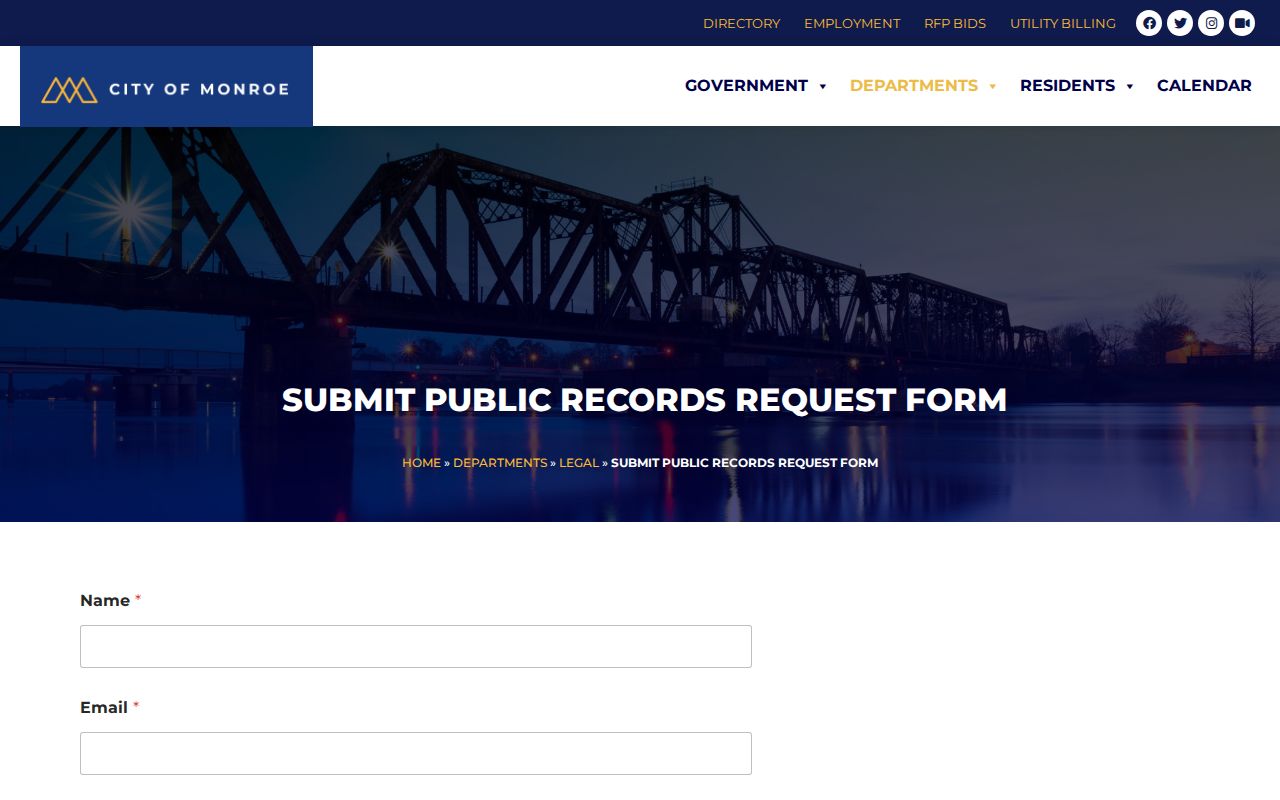
It reinforces that a detailed Record Message, not a broad name-only demand, is the practical route to a city-held police file.
Records at Monroe Police Department
MPD creates reports for incidents handled by its officers within city jurisdiction. The official Monroe city directory lists the police department and main telephone number, 318-329-2600. A caller should identify the records function and describe the precise item before visiting. The research did not establish that a citywide name-search portal replaces the request process.
Police records and court records are not interchangeable. MPD may preserve the initial narrative, probable-cause facts, officer information, evidence references, and arrest authority. It cannot certify the final disposition of a Fourth Judicial District Court case. For a certified outcome, use the court of record.
The official city directory is also the source for this MPD routing image.
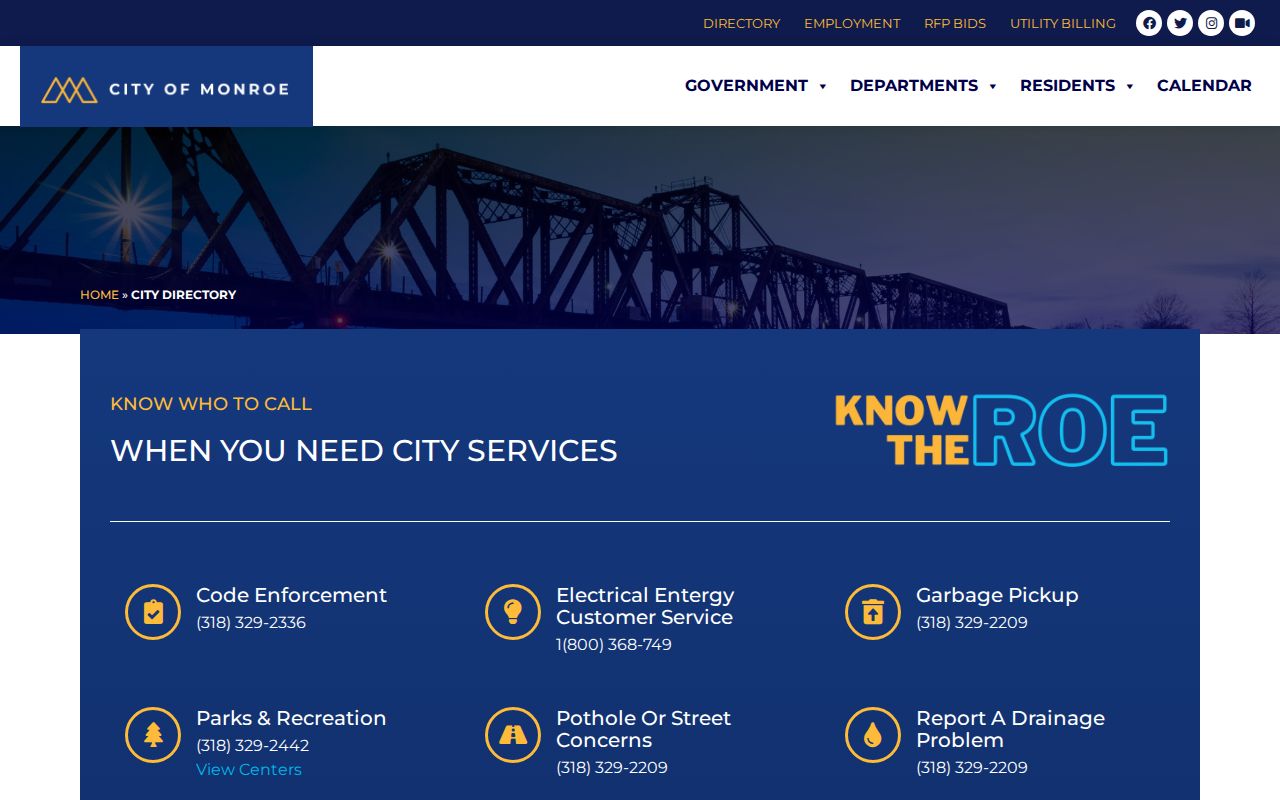
The directory is a routing aid. It does not merge MPD records with ULM Police, OPSO, or Troop F files.
Monroe Agencies Stay Separate
Monroe is the parish seat and main records hub, but nearby offices do not share one file cabinet. Downtown court and sheriff offices, ULM’s campus, I-20, and U.S. 165 create several plausible custodians. An event on university property can generate a ULM Police report. A state-route stop can belong to Troop F. An OPSO deputy working outside city limits creates an OPSO narrative even if OCC later lists Monroe as the booking location.
Check the arresting-agency field first. If the entry says MPD, request the narrative from Monroe. If it names another agency, direct the request there. OCC remains the booking custodian for all of them because it is the only parish jail. This distinction prevents wasted requests and avoids mistaking a booking record for the officer’s account.
Boundary check: A “Monroe” address alone does not identify the report custodian. Confirm the agency on the citation or OCC entry.
Booking and Arrest Records in Monroe
After an MPD arrest, the person goes to Ouachita Correctional Center at 4801 Highway 165 Bypass. OPSO operates OCC, and all parish law-enforcement agencies use it. The city police report stays with MPD. OCC creates a separate booking event with identity, intake time, arresting agency, allegations, and changing bond or custody data.
The official web bookings page is being reconfigured. OPSO directs users to the official OPSO app page for the latest booking information. Call OCC at 318-329-1200 to verify present custody or bond. A missing app result does not prove that no arrest occurred; spelling, release, transfer, or migration delays can affect results.
A booking allegation is not a conviction. The district attorney may decline, amend, or file charges later. Once filing occurs, the clerk’s docket becomes the source for pleas, motions, disposition, and sentence. Never send money after an unsolicited bond, ankle-monitor, or release-fee call. Verify through OCC’s published number.
After an I-20 Arrest
An I-20 event can touch MPD, WMPD, OPSO, or LSP. First obtain the arresting agency and booking number from the OCC entry. Request the narrative from that agency. Then determine whether the charge is municipal or was filed in Fourth Judicial District Court. The physical side of the river or a familiar postal label is not enough to pick the office.
If no district docket appears yet, filing may still be pending, the district attorney may have changed or refused the allegation, or the matter may remain in city court. Keep the booking number and report number. Those two identifiers let a clerk or records employee distinguish the arrest cycle from a later court case.
The Monroe Municipal Court File
Monroe City Court handles municipal, traffic, and limited criminal matters within its jurisdiction. The Monroe City Marshal is the enforcement arm of that court and serves Wards 3 and 10. City bench-warrant and process questions therefore belong with the city court or Marshal, not automatically with the district clerk or OPSO.
| Court Name | Monroe City Court |
|---|---|
| Case Types Heard | Municipal, traffic, and limited criminal matters within city jurisdiction |
| Case Lookup Channel | City court clerk or Monroe City Marshal for municipal process; verify directly |
| What the Docket Shows | Case identifier, charge or citation, events, warrants or process, and disposition when public |
| Copies & Fees | Ask the city court for current copy, certification, and access terms |
Felony and parish-level prosecutions belong in Fourth Judicial District Court. Search paid Clerk Connect after filing or contact the Ouachita Parish Clerk criminal counter. Do not use an MPD report as proof of the court outcome.
Marshal Process in Wards 3 and 10
The Monroe City Marshal’s official page identifies the office that serves Monroe City Court and Wards 3 and 10. That role matters when the question concerns city-court service, a municipal bench warrant, or enforcement of the city court’s process. It does not make the Marshal the custodian of an MPD investigative report or a 4th JDC felony file.
The official Marshal page supplied this local image.
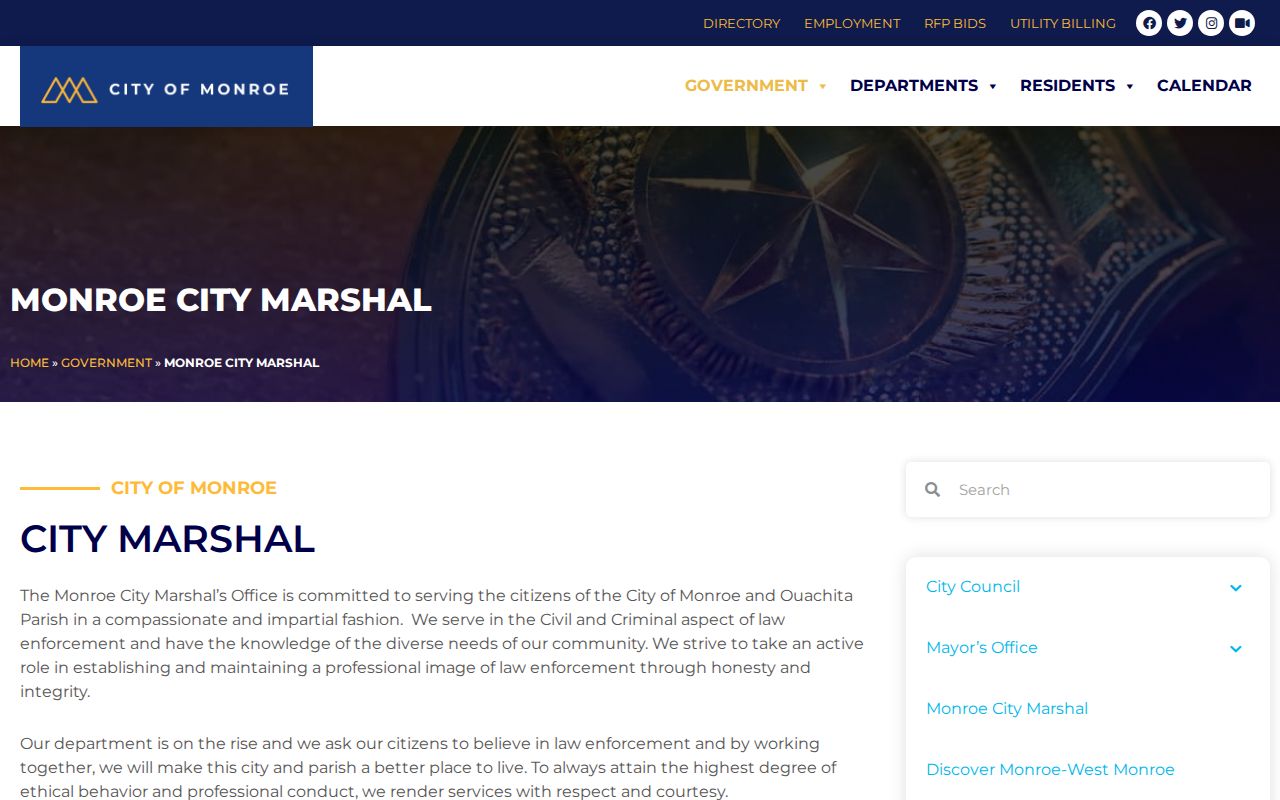
The image marks a distinct city-court route that is easy to miss when a search begins only with parish systems.
How Monroe Records Reach the County
MPD creates the incident or arrest file. OCC creates the booking. The district attorney decides whether and what to charge, and the clerk opens a 4th JDC case when a district prosecution is filed. Courts and agencies then report disposition data to Louisiana State Police BCII-LCJIS for the Louisiana Computerized Criminal History system.
Record flow: Monroe Police Department › Ouachita Correctional Center › Ouachita Parish courts › Louisiana State Police BCII-LCJIS
The flow is not instant, and each source keeps its own function. Use MPD for facts reported by officers, OCC for booking and current custody, city court for a municipal matter, and Clerk Connect for a filed district case. A subject seeking a statewide fingerprint-supported history should use the LSP Right to Review.
Monroe Victim Notice Is Different
Monroe Ordinance 12,253 provides a notable city service. The city is to maintain a policy or system giving crime victims timely information such as case-number assignment, incident-report creation, investigator identity, suspect arrest, significant case advancement, and availability of arrest records. The city may require a Louisiana Victim Notice and Registration Form.
That notification path is not a public people-search portal. It also differs from LA VINE, which addresses custody and supervision notification. A victim seeking case updates should ask MPD about the city process; a person tracking custody should use OCC or LA VINE; a requester seeking a public copy should use the records form.
Monroe Record Access Rules
The Louisiana Public Records Law applies to city-held public records, but law-enforcement exceptions remain. A custodian can redact protected information and should provide segregable public portions when possible. If a record is not immediately available, the law calls for a written certification and availability estimate within the statutory period. Inspection can reduce copy costs, while electronic delivery may be simpler for a narrow request.
Key statutes:
R.S. 44:1 defines the scope of Louisiana public records.
R.S. 44:32 governs inspection and copying procedures.
R.S. 44:33 sets custodian availability and response duties.
R.S. 15:587 limits dissemination of criminal-history information.
Sealed, expunged, juvenile, victim-identifying, active investigative, medical, and security-sensitive records may not be public. A dismissal does not itself erase an MPD or OCC record. A qualifying expungement requires a court order and agency processing.
Build a Monroe Request Packet
Keep the report number, booking number, court docket, and arresting-agency name together. Ask each custodian only for the record it creates. A narrow MPD request might seek the initial incident sheet and arrest information in electronic form. A city-court request should name the citation or docket. A 4th JDC request should identify the district case and whether certification is needed.
- Report number
- The police agency’s identifier for the incident or arrest narrative.
- Booking number
- OCC’s identifier for the jail intake event.
- Docket number
- The court’s identifier after a case is filed.
- Disposition
- The recorded court outcome, such as dismissal, plea, acquittal, or sentence.
Matching those identifiers keeps one event from being confused with another person or another arrest. It also makes a correction request more useful if a repository history lacks the court outcome.